Corn, Wheat, Tapioca, and Cassava Starch in Brewery Syrup Production
For a brewing adjunct syrup manufacturer, feedstock choice is not just a purchasing decision. It affects slurry handling, liquefaction stability, saccharification time, filtration load, final Brix, DE profile, viscosity, color, and how reliably the tanker matches the brewer’s specification.
BrixPilot works with syrup producers that need repeatable conversion across variable starch sources. As an enzyme supplier for brewing syrup production, our focus is practical: stable processing windows, predictable fermentability targets, dependable dosage behavior, and fewer off-spec shipments.
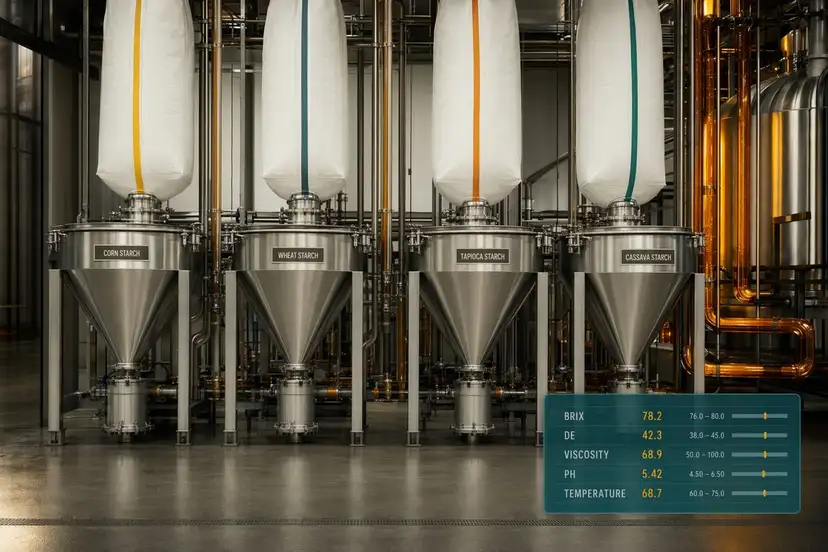
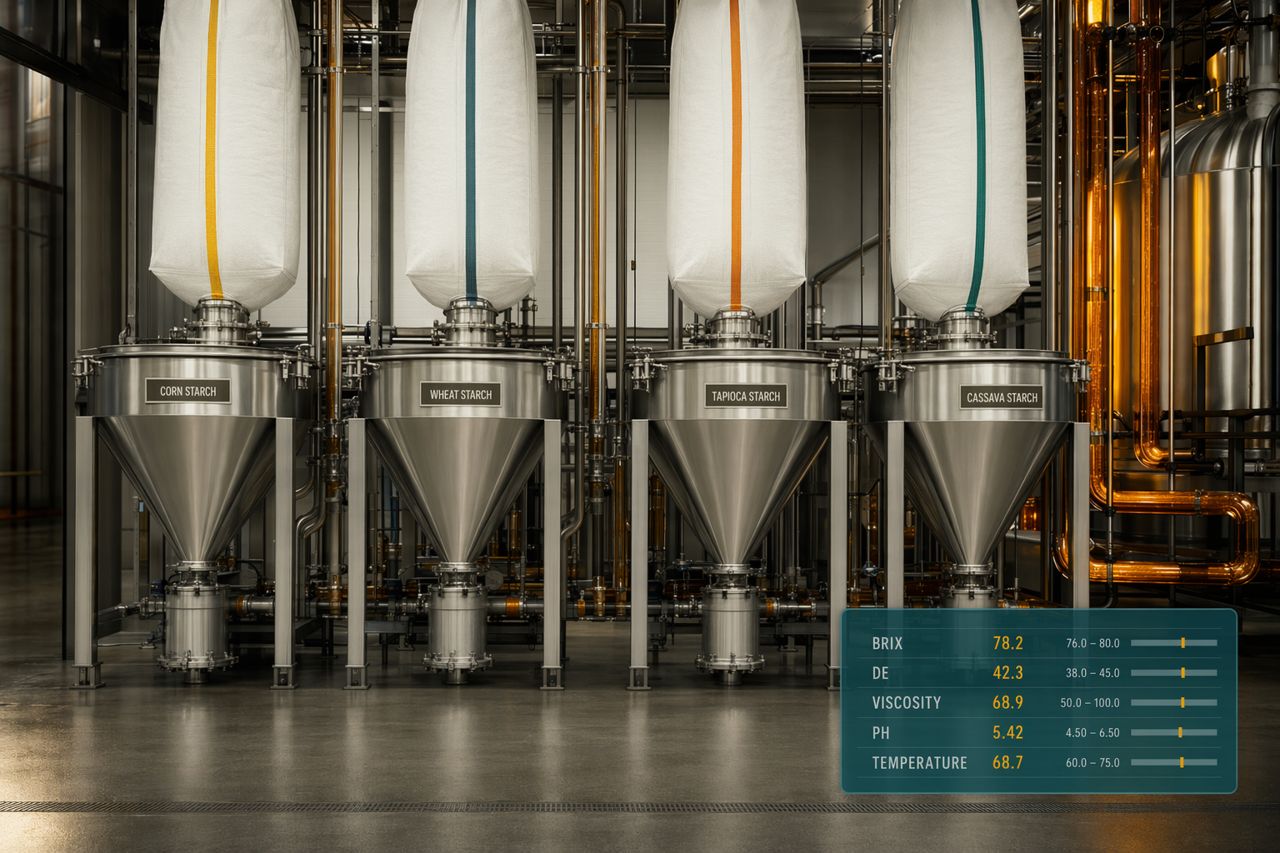
This guide compares four common starch bases for brewery adjunct syrup: corn, wheat, tapioca, and cassava.
What brewery syrup buyers expect from the plant
Brewers buying adjunct syrup usually care less about the starch source and more about performance in the brewhouse and fermenter. Your plant needs to deliver syrup that is:
- Consistent in Brix and dry solids
- Controlled in DE and fermentable sugar profile
- Pumpable at contracted temperature and loading conditions
- Low in haze-forming solids and filtration carryover
- Neutral enough for the brewer’s recipe and fermentation plan
- Stable from batch to batch, tanker to tanker, and campaign to campaign
Feedstock variation makes these targets harder. The right enzyme program helps absorb that variation without forcing operators into constant manual correction.
Corn starch: dependable scale, familiar conversion behavior
Corn is often the baseline feedstock for brewing adjunct syrup production because it is widely available, process-familiar, and well understood by operators.
Plant-floor advantages
- Reliable supply in many regions
- Familiar slurry behavior in standard wet milling and syrup systems
- Predictable gelatinization and liquefaction when cook conditions are controlled
- Good fit for high-volume syrup campaigns
- Established performance in brewer adjunct applications
Process watchpoints
Corn can still create issues when incoming starch quality shifts. Variable granulation, residual protein, fiber carryover, or aged inventory can influence viscosity rise, filtration load, and saccharification consistency.
For corn-based syrup, the enzyme program should support:
- Fast viscosity break during liquefaction
- Stable conversion under real plant pH and temperature drift
- Controlled maltose and glucose balance depending on brewer spec
- Clean finish without over-conversion that pushes syrup outside target profile
Best fit
Corn starch is often the strongest choice for large-scale plants prioritizing uptime, predictable scheduling, and repeatable tanker quality.
Wheat starch: useful performance, higher attention to non-starch components
Wheat starch can be a strong brewery syrup feedstock, especially where wheat processing infrastructure and local supply economics are favorable. It can produce clean, fermentable syrups, but it often requires closer attention to protein, pentosans, and filtration behavior.
Plant-floor advantages
- Regional availability in many grain-processing markets
- Can support clean syrup profiles with the right refining and conversion control
- Useful for producers with integrated wheat starch streams
- Flexible for certain fermentability and carbohydrate specifications
Process watchpoints
Wheat-derived streams may bring more non-starch complexity into the process. Even small changes in upstream separation can affect viscosity, foam tendency, filter pressure, and downstream clarity.
Operators should watch for:
- Slower or less predictable filtration
- Higher viscosity at comparable solids
- More sensitivity to protein and fiber carryover
- Batch-to-batch variation from upstream separation quality
An effective enzyme approach for wheat starch focuses on liquefaction reliability and downstream polish. The goal is not just conversion; it is stable movement through tanks, heat exchangers, filters, and loading arms.
Best fit
Wheat starch fits plants that can manage tighter raw material quality control and want to use regional supply advantage without sacrificing brewer-facing consistency.
Tapioca starch: clean profile and smooth handling when supply is controlled
Tapioca starch is valued for its relatively clean flavor contribution, low protein load, and smooth slurry behavior. For brewery syrup manufacturers, it can support high-quality syrups where neutral character and clarity are priorities.
Plant-floor advantages
- Low protein and low lipid contribution compared with many grain starches
- Good potential for clear, neutral syrup profiles
- Smooth viscosity reduction when liquefaction is well controlled
- Useful for premium or tightly specified adjunct syrup programs
Process watchpoints
The main challenge with tapioca is usually not conversion chemistry; it is supply consistency. Moisture, storage conditions, origin, and shipment variability can all influence how a batch behaves in the plant.
Key control points include:
- Incoming moisture and starch quality
- Slurry make-up consistency
- Heat transfer during gelatinization
- Enzyme dispersion in higher-solids systems
- Final viscosity at loading temperature
Best fit
Tapioca starch is a strong option when the plant has disciplined incoming inspection and wants a clean syrup profile with dependable pumpability.
Cassava starch: similar base, different procurement and process realities
Cassava starch is closely related to tapioca in practical syrup applications, but plants should treat it as a specific supply and process category rather than assuming identical behavior from every shipment.
Plant-floor advantages
- Can deliver clean, neutral syrup characteristics
- Often attractive in regions with established cassava starch production
- Low non-starch burden when well refined
- Good candidate for brewery adjunct syrups requiring clean fermentability
Process watchpoints
Cassava quality can vary with origin, drying, storage, and age. Poorly controlled material may create inconsistent slurry hydration, unexpected viscosity behavior, or higher insoluble load.
For cassava-based syrup, enzyme selection should help stabilize:
- Initial viscosity break
- Dextrin distribution during liquefaction
- Saccharification endpoint control
- Pumping and filtration performance at production solids
Best fit
Cassava starch works well where regional supply is strong and the producer has the process discipline to qualify suppliers, monitor incoming material, and adjust conversion windows without disrupting production schedules.
Feedstock comparison for brewery adjunct syrup plants
| Feedstock |
Main strength |
Main plant concern |
Best operational fit |
| Corn starch |
Scale, familiarity, predictable conversion |
Quality shifts can affect viscosity and filtration |
High-volume, repeatable production |
| Wheat starch |
Regional supply advantage, flexible syrup profiles |
Protein and non-starch components can affect filtration |
Plants with tight upstream separation control |
| Tapioca starch |
Clean profile, smooth handling potential |
Supply and moisture variability |
Neutral syrup programs with strong raw material checks |
| Cassava starch |
Clean syrup potential, regional economics |
Origin and storage variability |
Plants close to reliable cassava starch supply |
The enzyme program must match the feedstock, not just the tank size
A brewing syrup plant may run similar equipment across different feedstocks, but the conversion behavior can change quickly. The same dosing habit that works for one starch source can create viscosity hold-up, under-conversion, over-conversion, or a tanker that misses fermentability expectations on another.
BrixPilot supports enzyme selection around the operating realities that matter most:
- Liquefaction stability: rapid viscosity reduction without creating downstream instability
- Saccharification control: predictable fermentable sugar profile for brewer specifications
- Dosage reliability: practical plant dosing that operators can repeat across shifts
- Process tolerance: performance through normal pH, temperature, and solids variation
- Filtration support: lower risk of pressure spikes, slow polish, and haze carryover
- Tanker consistency: fewer corrections before loading and fewer customer claims after delivery
The objective is not simply to convert starch. The objective is to convert starch into a dependable brewing adjunct syrup at production speed.
Where off-spec syrup usually starts
Most off-spec issues do not appear suddenly at the loading arm. They build earlier in the process.
Common causes include:
- Incoming starch variation that is not reflected in the enzyme plan
- Poor viscosity break during liquefaction, creating downstream residence-time problems
- Saccharification drift that moves the syrup outside the target carbohydrate profile
- Inconsistent dosing practice across operators or shifts
- Filtration overload from non-starch components or incomplete process control
- Final viscosity mismatch at loading temperature, causing pumping or customer handling issues
A practical enzyme supplier helps the plant connect these symptoms to process decisions before they become rejected or discounted tankers.
Choosing a feedstock strategy
For many plants, the best strategy is not a single universal starch source. It is a controlled feedstock plan backed by a conversion program that can handle commercial reality.
Ask these questions before committing capacity:
- Can the raw material supplier hold consistent moisture, purity, and particle quality?
- Does the starch source support the brewer’s fermentability and flavor expectations?
- Can the plant maintain viscosity control at target solids?
- Will filtration stay stable through a full production campaign?
- Can operators dose and verify the enzyme program reliably across shifts?
- Does the finished syrup load cleanly at the required temperature and Brix?
If the answer depends on constant manual correction, the process is not yet robust enough.
Work with BrixPilot on feedstock-specific enzyme selection
BrixPilot helps brewing adjunct syrup manufacturers align enzyme selection with real production constraints: starch source, solids target, tank residence time, viscosity limit, fermentability specification, and loading requirements.
Whether your plant is running corn, wheat, tapioca, cassava, or multiple starch streams, we can help define a practical enzyme approach for consistent brewery syrup output.
Ready to compare options for your plant? Use the on-site request a quote form and tell us your feedstock, target syrup profile, process conditions, and current bottleneck. BrixPilot will respond with a fit-for-purpose recommendation for your production line.
Request a quote