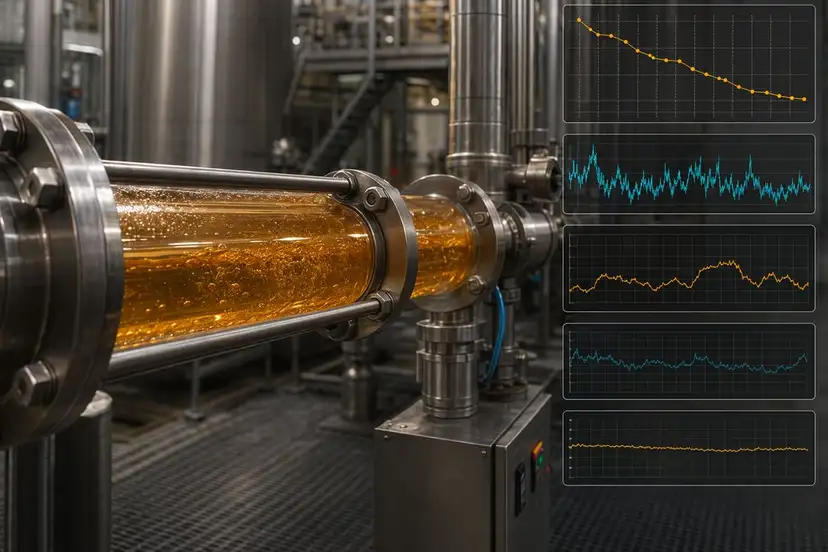
DE Drift in Starch Syrup Plants | BrixPilot
Process-focused guide for brewing adjunct syrup manufacturers troubleshooting DE drift, viscosity instability, fermentability variation, and off-spec tanker risk before blaming the enzyme.
Request pricing Process-focused guide for brewing adjunct syrup manufacturers troubleshooting DE drift, viscosity instability, fermentability variation, and off-spec tanker risk before blaming the enzyme.
Request pricingFor a brewing adjunct syrup manufacturer, DE drift is not an abstract lab concern. It shows up as viscosity movement, fermentability variation, filtration pressure, delayed loading, and more conversations about whether a tanker is inside the customer’s operating window.
The enzyme is often the first suspect. Sometimes it should be investigated. But in many starch syrup plants, DE drift is a process signal before it is a supplier problem. Slurry solids, pH, heat transfer, residence time, mixing, dosing reliability, and sampling discipline can all shift conversion outcomes while the enzyme itself remains unchanged.
BrixPilot works as an enzyme supplier for brewing syrup production with a plant-floor view of conversion control. The goal is not to defend an ingredient. The goal is to help your team tighten the process band so each load behaves predictably in the brewhouse.
Adjunct syrup buyers care about consistency because their fermentation process is built around predictable carbohydrate composition and handling behavior. When DE moves, the impact can cascade through the commercial relationship:
A small conversion shift can become a scheduling problem when the plant is running tight. The practical question is simple: what changed in the conversion window?
DE reflects the combined result of starch quality, liquefaction, saccharification, thermal history, pH control, enzyme contact, mixing, hold time, and finishing operations. Treating DE as a direct measure of enzyme performance can lead the troubleshooting process in the wrong direction.
A better first step is to ask: did the enzyme receive the same process conditions as the last in-spec run?
If the answer is uncertain, the investigation should start with the plant conditions around the enzyme before changing dose, switching lots, or escalating supplier claims.
Dry solids variation changes conversion kinetics, heat transfer, viscosity, and enzyme contact. In practice, slurry strength can shift because of starch moisture variation, make-up water control, condensate recovery, line flushes, tank heel management, or recirculation behavior.
When solids drift upward, viscosity can rise and mixing can become less uniform. When solids drift downward, residence time and thermal exposure may not align with the intended conversion profile. Either direction can move DE.
Plant-floor check: compare starch receiving data, slurry tank level behavior, water addition trends, and any recent changes to reclaim streams or tank changeover routines.
A pH value that looks acceptable at a single sample point may not represent the vessel, the pipe run, or the period immediately after chemical addition. Buffering changes in the starch stream, inconsistent chemical strength, poorly mixed acid or caustic addition, and CIP carryover can all create hidden pH movement.
Enzymes used in syrup conversion are process tools. They need the right pH environment to perform consistently. If pH shifts during liquefaction or saccharification, the finished DE can move even when enzyme dose and lot remain the same.
Plant-floor check: review pH trend timing against chemical addition, CIP return risk, tank turnovers, and sample location. Look for step changes at startup, after sanitation, or after feedstock changes.
Temperature is often monitored, but heat history is not always uniform. Steam pressure variation, jet cooker condition, exchanger fouling, insulation losses, sensor placement, and vessel stratification can all change the actual exposure of the starch stream.
Liquefaction is especially sensitive because it sets the viscosity and dextrin profile that saccharification must finish. Under-processing can leave saccharification chasing a heavy, uneven substrate. Over-processing can change the carbohydrate profile and downstream handling.
Plant-floor check: compare temperature trend stability, steam valve behavior, start-of-run warm-up, exchanger cleanliness, and any maintenance work near cooking or holding equipment.
Flow rate, tank level strategy, bypass valve position, recirculation path, and line routing can change residence time. A plant may believe it is running the same recipe while the material is spending more or less time in the active conversion window.
Short residence time can leave conversion incomplete. Excessive hold time can push the profile beyond the intended target, especially if the process remains warm and active.
Plant-floor check: map actual flow path during in-spec and off-spec runs. Confirm no temporary bypass, partially open valve, level-control change, or modified transfer schedule has altered hold behavior.
Enzyme performance depends on contact. If mixing is uneven, the process can create zones of high and low conversion in the same vessel. This is common when viscosity rises, impellers are worn, recirculation is reduced, or enzyme is injected into a poorly distributed stream.
Poor dispersion can also create false confidence. The average batch may test near target, while individual tankers show variation because the vessel was not homogeneous at transfer.
Plant-floor check: observe recirculation intensity, agitator condition, injection point location, tank geometry, and transfer sequencing. Verify that samples represent the loaded material, not a calm pocket near an easy draw point.
The control system may show the intended setpoint, but the physical addition system can still vary. Dosing pump slip, loss of prime, air entrainment, plugged injection quills, hose softening, check valve wear, low tote head pressure, and manual changeover errors can all affect delivered enzyme.
This is the point where the enzyme supplier should be involved, but the conversation should be evidence-based. The question is not only what dose was entered. It is what dose was actually delivered into a well-mixed process stream.
Plant-floor check: review pump stroke behavior, tote weight change, line condition, injection pressure, prime status, and changeover records. Look for drift after maintenance, tote swaps, or recipe edits.
Not all starch inputs behave the same. Moisture, granule condition, protein, fiber, ash, storage history, and seasonal procurement changes can influence liquefaction response. A process window that is stable for one starch profile may become narrow when the feedstock changes.
Plant-floor check: compare supplier lots, storage age, unloading conditions, and any receiving notes from the period when DE began drifting.
DE drift can be created in conversion, but it can also be misread because of finishing and sampling behavior. Evaporation concentration changes, tank stratification, line flush dilution, filter hold-up, or non-representative sampling can make a stable process look unstable.
Plant-floor check: separate true conversion drift from concentration, blending, and sample timing effects. Match each sample to the tank, transfer path, and finishing step it represents.
When DE moves, avoid changing too many variables at once. A disciplined review usually finds the signal faster.
Build a simple run history around the first off-target result. Include feedstock lot, slurry preparation, pH adjustment, liquefaction conditions, saccharification conditions, enzyme addition, filtration, evaporation, storage, and loading.
Do not compare against the recipe alone. Compare against an actual run that produced acceptable syrup. Look for differences in solids, heat-up behavior, hold strategy, pump status, tank routing, and operator interventions.
Confirm that the enzyme tote, pump, tubing, injection point, and line pressure match the intended addition plan. A clean setpoint trend is useful, but it does not replace a physical check.
If the team changes pH target, enzyme dose, hold time, and solids correction in the same run, the result may improve without teaching the plant anything. Stabilize the most likely process variable first, then confirm the response.
A good supplier conversation includes operating context: trend screenshots, batch chronology, feedstock changes, addition system status, and the exact commercial target. That makes it possible to recommend a process-fit enzyme strategy instead of a generic correction.
BrixPilot supports adjunct syrup producers with enzyme selection and process-fit troubleshooting for liquefaction and saccharification. When a plant reports DE drift, we focus on the operating window around the enzyme:
The aim is a dependable conversion profile: predictable fermentability, manageable viscosity, fewer holds, and fewer off-spec tankers.
Process causes should be checked first, but enzyme-related issues can still occur. Packaging damage, storage exposure, expired inventory, incorrect product selection, misidentified tote, or a mismatch between enzyme system and current feedstock can all affect results.
The key is to separate supplier quality questions from process condition questions. That protects uptime and helps both sides move quickly toward a corrective action.
DE drift is rarely solved by chasing a single reading. The better target is a narrower, more repeatable conversion band. For brewing adjunct syrup plants, that means stable viscosity through the process, predictable fermentability for customers, and a release process that does not depend on last-minute correction.
If your plant is seeing recurring DE movement, BrixPilot can review the conversion window and recommend enzyme options that fit your process conditions.
Request a quote through the on-site form and include your syrup target, starch source, current process outline, and where the drift is showing up.
Tell us your application and volume — we reply with pricing and lead time.